
Moorestown City Directory Holdings
Moorestown city directory research begins with several shelves rather than one master volume. The strongest documented run is in a regional Burlington County city-directory finding aid that lists publications including Moorestown. The Historical Society of Moorestown also identifies city directories among its local collections. A later local checkpoint is the digitized 1987-88 Moorestown Town Phone Book. Each source has a different purpose, so record the exact title, year, reel or PDF page, and the wording of the entry.
| Collection | Years | Where held | Access |
|---|---|---|---|
| Burlington County directories that include Moorestown | 1883-84, 1886, 1887, 1889-90, 1893-94 through 1905-06, 1910-11, and 1929 | Regional microfilm finding aid; Historical Society reports city directories | Request or inspect the exact reel and volume |
| Moorestown Town Phone Book | 1987-88 | Moorestown Library local-history digital collection | Direct PDF with people, organizations, and ZIP-area material |
| Historical Society directory and local files | Specific city-directory runs not located in the reviewed sources | Smith-Cadbury Mansion, 12 High Street | Non-lending research collection; copying and scan rules apply |
| State archival and county context | Collection-dependent | New Jersey State Archives | Catalog, onsite research, or request route for historic records |
The finding aid does not prove that every listed year has the same Moorestown coverage, or that every line names a resident. Treat it as a route to a specific item. The publisher for the full Moorestown historical run and a final printed year were not located in the official sources reviewed. Note: A missing volume is a collection gap, not proof that a household left Moorestown.
Moorestown Directory Years
The Moorestown dated record is useful because it makes gaps visible. The documented Moorestown sequence starts with 1883-84, then includes 1886 and 1887, 1889-90, several runs from 1893-94 through 1905-06, 1910-11, and 1929. The later 1987-88 phone book is a separate local artifact. It should not be treated as proof of a continuous publication chain between those points. Moorestown directory volumes can therefore establish a time-stamped association, while the absence of a listing may reflect a skipped edition, a canvassing limit, or an editorial choice.
- 1883-84: earliest documented Burlington County directory volume in the finding aid that includes Moorestown.
- 1886 through 1905-06: intermittent volumes listed for the county, with Moorestown coverage to verify inside each title.
- 1910-11 and 1929: later documented entries before the local phone-book checkpoint.
- 1987-88: Moorestown Town Phone Book preserved as a digitized local-history item.
Use the nearest available years around a family event or known move. A released census schedule can supply a household snapshot, but its date will seldom match a directory exactly. Pairing close years is more honest than forcing a directory entry to answer a question it cannot answer.
Moorestown Directory Research Shelves
The Historical Society of Moorestown research library is a key local stop because its holdings include city directories, yearbooks, maps, photographs, diaries, scrapbooks, family files, organization files, and home and building pamphlets. It is at Smith-Cadbury Mansion, 12 High Street. The listed public research hours are Tuesday from 1 to 4 p.m. and the second Sunday of each month from 1 to 3 p.m., generally excluding July and August. The collection does not lend material, and its copying, image-scan, and rights rules are separate.
The Historical Society’s library holdings page shows the local research setting behind these Moorestown directory collections.
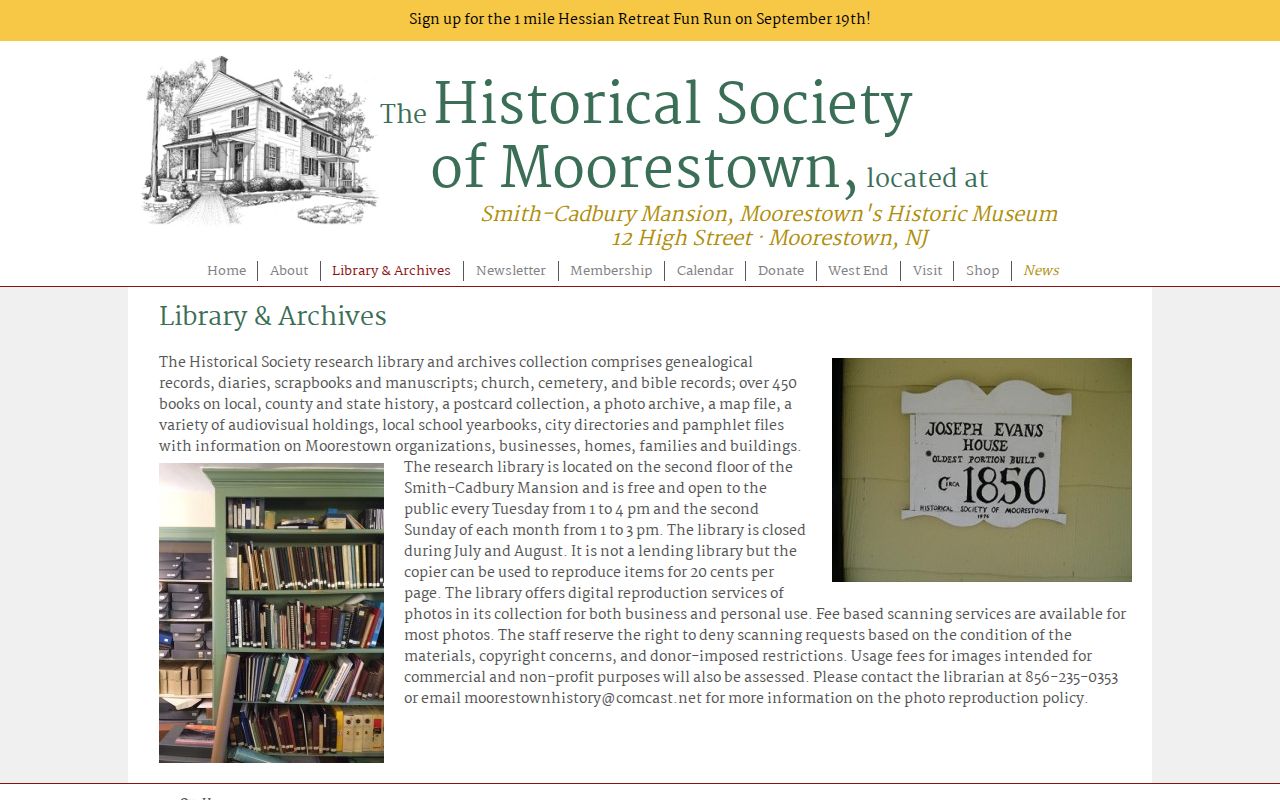
The Moorestown shelf matters because a surname can be checked against nearby family, home, school, church, cemetery, and map material without turning one printed line into a complete identity claim.
Moorestown Library, at 111 W 2nd Street, is another local access point and publishes its public hours and phone number, 856-234-0333. Ask for a defined title or date range. The municipal staff directory and library contact route are better starting points than assuming that every historic item is online.
Reading a Moorestown Directory Entry
A Moorestown city-directory line is strongest when it is transcribed as printed. The Library of Congress explains that typical volumes are arranged alphabetically by surname and may give an address, a telephone number, and an occupation or professional description. The Moorestown research set did not retain a page-level named entry or a local abbreviation key. That is a real research gap. Use the entry as a lead, then compare it with a Moorestown deed, map, newspaper, census-era source, or a historical-society file.
| Name | Record the surname, given name, initial, and exact spelling shown in the volume. |
|---|---|
| Address | Copy the house number and street line exactly, then keep a separate standardized version for searching maps. |
| Telephone or organization | Note any phone line or organization label, but identify whether the entry is personal, institutional, or commercial. |
| Family notation | Preserve a spouse, widow, or household notation only when it appears in the item. |
| Occupational description | Use it as the directory’s dated editorial label, not as a present-day status claim. |
- Criss-cross directory
- An address-ordered directory that can connect a street line to an occupant listing. A separately named Moorestown run and its years were not located.
- Householder index
- An index organized around a household name. Confirm how a specific volume arranges entries before relying on it.
- Abbreviation key
- The volume’s own explanation of shortened labels. Photograph or transcribe it first when it is present, because no Moorestown key was captured.
Keep two forms of each Moorestown entry in the notes: the line exactly as printed and a separate search form. The printed form preserves initials, punctuation, old street terms, and a directory editor’s wording. The search form can expand a first name, standardize a street suffix, or test a former name. Do not overwrite the original with the normalized version. When the two forms lead to different results, compare the date, address, household notation, and the record type before treating either result as the same person.
When Moorestown Directories Have Gaps
A blank in a Moorestown volume does not settle whether someone lived there. Publishers worked from canvassing and published on their own schedules. A person might be omitted, listed by an initial, named under a spouse or organization, or recorded at a prior address. The Library of Congress directory guide specifically cautions that coverage can be irregular and a listing can lag a move. Search close years, spelling variants, married or former names, and historical place-name forms before treating an absence as meaningful.
The Moorestown phone book preserves Chestertown, Rodmantown, Moore’s Town, and Moorefield as historical name clues. Those are search pivots in old newspapers, map captions, deeds, and Moorestown files, not alternate current municipalities. Keep the original wording in the Moorestown research log, alongside the catalog title and the page or image consulted.
Moorestown Directory Name Clues
The 1987-88 phone book offers more than a list of lines. Its local-history introduction places the Moorestown Post Office name in 1802, notes the first Friends meeting house in 1700, and marks railroad arrival in 1867. These details help explain why an older directory, deed, or newspaper may use a place name that does not look like the current one. They do not identify a person by themselves. The useful practice is to search a name alongside the dated place term, then preserve the source context.
The Library of Congress city-directory guide explains the typical arrangement and coverage limits that shape this Moorestown search.
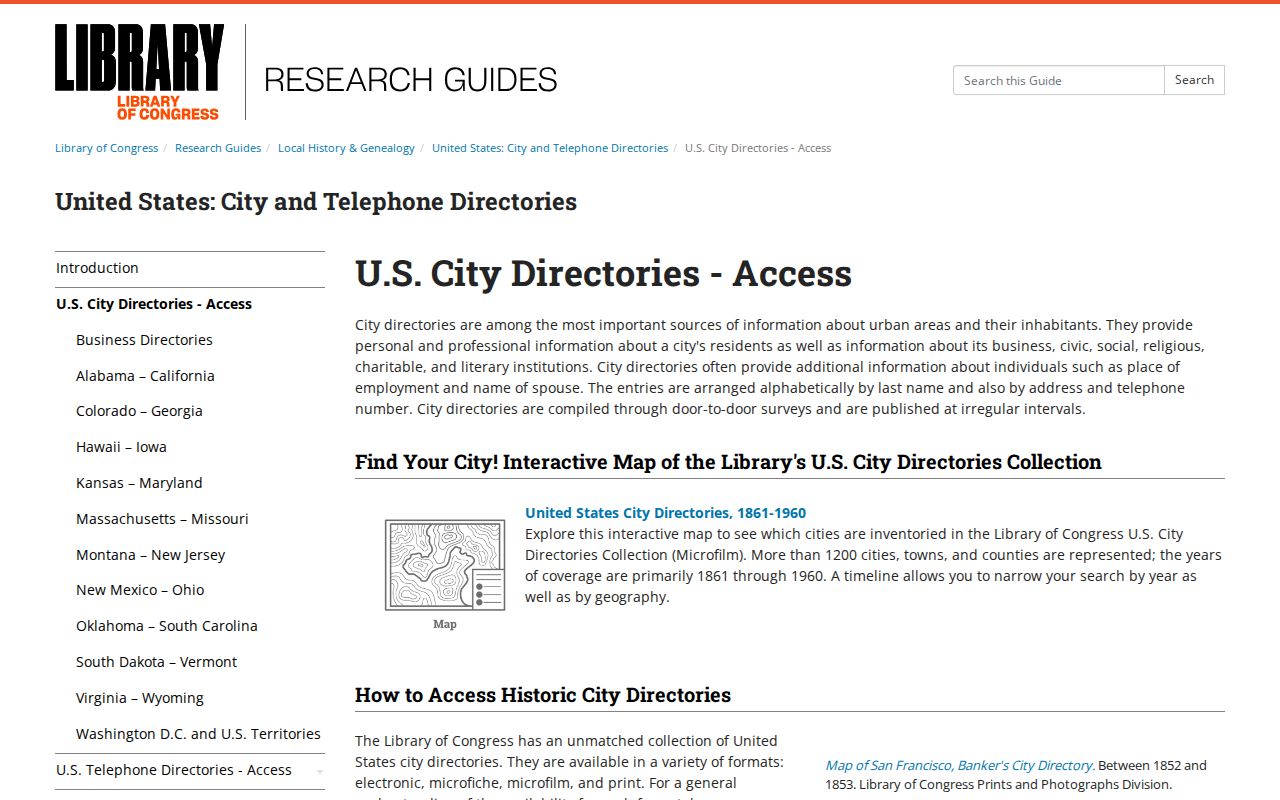
The Library of Congress guidance reinforces the practical Moorestown limit: a directory is evidence of a dated publication process, so an address sequence needs confirmation from the original records behind it.
Tracing Families in Moorestown Directories
For family history, begin with the first documented Moorestown directory entry, not with a conclusion about the person. Write down the title, year, page, spelling, address, telephone, and any household or organization label. Then work outward through the next available volume. The documented gaps mean that a sequence may jump several years. That is normal. A released census schedule can test household composition near a directory year, while deeds, newspapers, church and cemetery files, and estate material can test the address or family connection.
- Locate the surname in a dated Moorestown or Burlington County volume and record the page or image.
- Check the next available directory year for the same spelling, an initial, a spouse notation, or a changed street line.
- Compare the address with a tax map or a recorded instrument if the question concerns a parcel rather than an occupant.
- Pair the nearest released census year with the directory year, noting that the two dates do not match exactly.
- Use newspapers, church or cemetery material, and the State Archives only as separate dated sources, not as automatic proof of one identity.
The Moorestown resident lookup route is useful only after the historical entry has been anchored to a date and record type. Names that match in one town and one volume should still be treated as separate people until another independent source supports the connection.
Moorestown Directory Archive Checks
When the local shelf stops, the New Jersey State Archives genealogical collections can add older Burlington County deed, estate, marriage, naturalization, and related record routes. The Archives identifies a Burlington County Surrogate estate index for 1785-1970 and deed material beginning in 1785. These are archival series, not a substitute directory. A name must still be tested against its date, place, and the original item.
The State Archives genealogy guide identifies the historic collection categories that can extend a Moorestown directory trail.
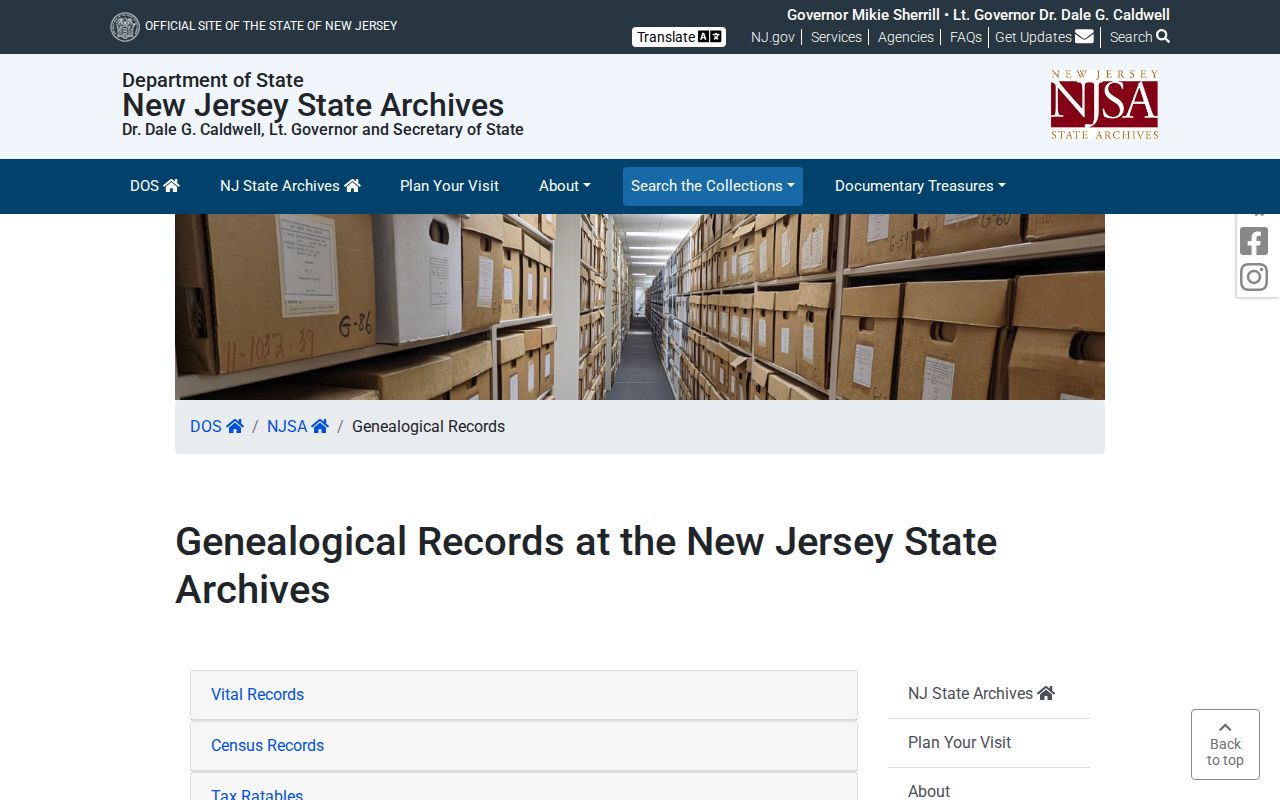
Archive materials work best as a second layer: a Moorestown directory supplies the dated clue, and a deed, estate index, church record, or map supplies a specific piece of supporting evidence.